
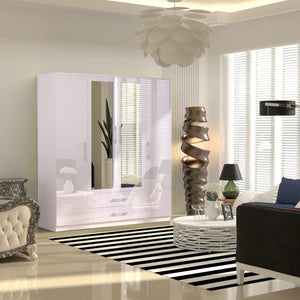
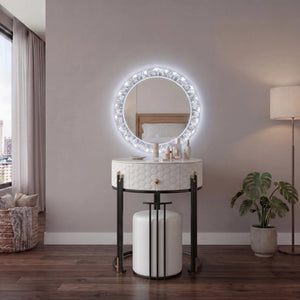
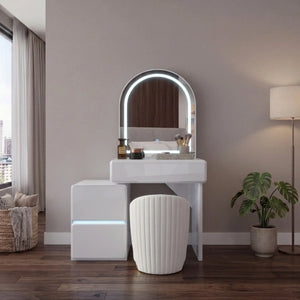
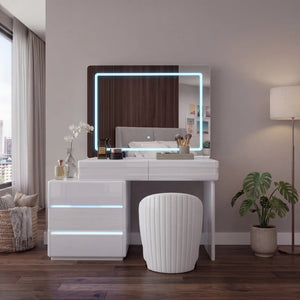
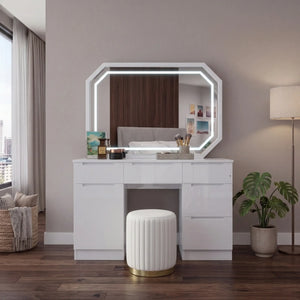
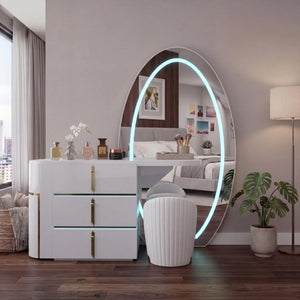


Scroll through any bedroom inspiration page, and you will notice something. The ceilings are four metres high. The window runs the length of one wall. There is no radiator anywhere. The wardrobe is a walk-in dressing room in disguise.
Now look at your actual bedroom. Low ceiling, one window with a radiator underneath it, a chimney breast eating the middle of a wall, and just enough floor for a bed and a way past it.
British bedrooms are among the smallest in Europe. That is not a design failure. It is just the housing stock we have. The good news is that modern design works brilliantly in small rooms, as long as you stop copying photos of houses that look nothing like yours.
This guide covers what actually works in a real UK bedroom.
What Actually Makes a Bedroom Look Modern
Strip the word "modern" back, and it comes down to four things.
-
Clean lines with no fussy detail, carving or heavy trim.
-
A calm colour palette built on two or three shades.
-
Fewer things on show, with storage doing the hiding.
-
Light from several sources rather than one bulb.
That is it. Modern is not a shopping list of specific items. It is a set of decisions about restraint. A room with three well-chosen pieces looks more modern than a room with nine expensive ones.
The most common mistake is thinking modern means cold. It does not. The current UK direction is warm minimalism. Clean shapes, soft textures, gentle colour. Sharp edges with nothing soft around them read as clinical rather than calm.
Start With the Room You Actually Have
Before any styling decision, know your numbers. Room size dictates almost everything that follows.
|
Room type |
Typical UK size |
What it realistically holds |
|
Box room |
6 to 7 m² |
Single bed, one slim storage piece. |
|
Single bedroom |
7 to 9 m² |
Single bed, wardrobe, small bedside. |
|
Standard double |
11 to 13 m² |
Double bed, wardrobe, chest, two bedside tables. |
|
Master bedroom |
14 to 20 m² |
Larger bed, full storage wall, seating. |
Most UK doubles sit around 12 m². That is enough for a proper scheme, but it is not enough for a bed floating in the middle of the room with space to walk around all four sides. Every inspiration photo was shot in a room twice your size.
Measure your room and write the numbers down. Then judge every idea against those numbers rather than against a photo.
The One Wall Rule

This single decision changes small rooms more than anything else.
Put all your tall storage on one wall. Leave the others clear. A run of wardrobes along a single wall reads as architecture. The same wardrobes split across three walls read as clutter, even though the volume is identical.
Your eye needs somewhere to rest. When furniture is scattered, there is no rest, and the room feels busy no matter how nice each piece is. When it is grouped, the empty walls do the work of making the space feel bigger.
The rule extends to height. Go tall on that one wall rather than wide across several. A tall unit uses air rather than floor, and floor is the thing you are short of.
Design Around the Radiator, Not Against It
Almost every UK bedroom has a radiator under the window. Almost no inspiration photo shows one. So people plan a scheme, then discover a large white panel in the middle of it.
Work with it rather than pretending it is not there.
Do not push furniture against a radiator. It blocks the heat, wastes your money, and can damage the finish over time. Leave a gap. A chest of drawers pushed tight against a hot panel will not thank you in February.
The space under a window is usually the worst place for storage anyway. It is the brightest part of the room, and blocking it costs you light. Keep it clear, or use something low there if you must.
If the radiator genuinely ruins a wall, a slim cover turns it into a shelf. That gives you a surface for a lamp and a plant, which is more useful than a bare panel.
Chimney Breasts and Alcoves Are Free Storage

Victorian terraces and 1930s semis usually come with a chimney breast in the bedroom. Most people treat it as a problem. It is closer to a gift.
The two alcoves on either side are the right depth for storage. They are already framed, so anything you put there looks built-in without any building. A wardrobe in an alcove sits flush and reads as part of the wall.
Measure both alcoves before you buy anything. They are rarely the same width, even in the same room. Old houses were not built to millimetres, and a piece that fits the left one may not fit the right.
The chimney breast itself is the natural place for the bed. It centres the room and gives the headboard a wall of its own.
Getting the Colour Right in British Light
This is the part almost nobody mentions, and it decides more than the colour name does.
British daylight is not neutral. A north-facing bedroom gets cool, blue-toned light and never sees direct sun. In that light, grey drains out and looks flat. The room feels colder than the thermostat says. A south-facing bedroom gets warm light for hours, and that same grey looks rich and expensive.
Check your window before you check any paint chart.
-
North-facing, lean warm. Soft whites, warm greys, creamy neutrals.
-
South-facing, cooler shades hold up fine. Grey looks good here.
-
East or west facing, most palettes work, so choose on other grounds.
Keep the palette to two or three shades. Modern schemes are built on restraint, not variety. If you want the full breakdown of the two most common choices, this comparison of white and grey bedroom furniture is worth thinking through before you commit, since the same unit in a different colour changes the whole room.
Modern Storage Without Building Anything
Here is where most design advice quietly assumes you own your home and have a joiner's budget.
Fitted wardrobes look excellent. They also cost thousands, need a survey, take weeks, and stay behind when you move. For a lot of people that maths never works.
Freestanding furniture gets you the same modern look for a fraction of the cost. The trick is choosing pieces that behave like built-ins. Tall units that reach for the ceiling. Flat, handleless fronts. One colour across everything. Grouped on a single wall.
Do that and a run of freestanding wardrobes reads almost like joinery from across the room. Nobody walking in counts the gaps.
Renters gain the most from this approach. No drilling, no landlord permission, no arguments about the deposit. The furniture is yours, and it moves house with you.
Keep the finish consistent across the room. A matching hest of drawers and bedside tables do more for a modern look than any single expensive piece, because the eye reads a set rather than a collection.
Lighting Is the Cheapest Upgrade
One bulb in the middle of the ceiling is the fastest way to make any room look ordinary. It flattens everything and throws hard shadows.
Modern rooms use layers. Three light sources at different heights beats one bright one every time.
-
A soft ceiling light with a dimmer for general light.
-
Bedside lamps or wall lights at head height for reading.
-
Something low and warm, like an LED strip or a floor lamp, for evenings.
None of this needs an electrician. Plug-in wall lights, battery sensor strips inside a wardrobe, and a decent lamp will transform a room for under a hundred pounds. This is the highest return on money in the whole guide, and it works in a rental.
Swap cold blue bulbs for warm white ones while you are at it. Colour temperature does more for atmosphere than the fitting does.
What Makes a Bedroom Look Dated in 2026
Sometimes the fastest route forward is removing things rather than adding them.
Heavy matching bedroom suites in dark wood are the biggest offender. A bed, wardrobe, chest, dressing table and mirror all in the same ornate wood reads as a showroom from twenty years ago.
Cold grey everything is fading too. Grey had an enormous decade in Britain, and the mood has moved to warmer neutrals. Grey is not dead, but grey walls with grey carpet and grey furniture and a grey throw is very much a period piece now.
The single overhead bulb dates a room instantly. So does clutter on every surface. So does a feature wall in a loud pattern with nothing else supporting it.
Ornate handles on plain furniture, a bed pushed under the window blocking the light, and curtains that stop halfway down the wall all pull a room backwards. None of these cost money to fix.
Modern Bedroom Ideas That Work in a Rental
Roughly one in five UK households rents privately. Almost no design content is written for them.
You can get most of the way there without touching the walls.
-
Freestanding storage instead of fitted, grouped on one wall.
-
Plug-in and battery lighting instead of wired fittings.
-
Peel-and-stick options for anything you want to reverse later.
-
Textiles doing the colour work, since they leave when you do.
-
A large rug to cover a carpet you did not choose.
The furniture is the part worth spending on, because it is the part you keep. A landlord's magnolia walls matter far less than people think once the room has good storage, warm light and a calm palette.
What It Actually Costs
Design content tends to skip this, or quote fitted prices that make the whole thing look impossible.
|
Approach |
Rough cost |
What you get |
|
Styling only |
£100 to £300 |
Lighting, textiles, declutter, paint. |
|
Freestanding refresh |
£600 to £1,500 |
Wardrobe, chest, bedside, plus styling. |
|
Fitted wardrobes |
£2,000 upward |
Built-in joinery, survey, install. |
The middle row is where most UK bedrooms land, and it gets you ninety per cent of the look. The gap between a good freestanding scheme and full joinery is smaller than the price difference suggests.
Putting It Together
A modern UK bedroom is not a style you buy. It is a sequence of decisions.
Measure the room honestly. Pick the storage wall. Work around the radiator and use the alcoves. Choose a palette that suits your window rather than someone else's. Group your furniture, go tall, keep the finish consistent. Add three layers of light. Take one thing out.
Do those in order, and the room looks considered. Skip them, and no amount of styling saves them. The rooms that work are rarely the ones with the biggest budgets. They are the ones where somebody thought about the space they actually had.
FAQs
What makes a bedroom look modern?
Clean lines, a calm two- or three-colour palette, storage that hides clutter, and layered lighting. Restraint matters more than any single item you buy.
What are the best modern bedroom ideas for small UK homes?
Put all tall storage on one wall and leave the rest clear. Go tall rather than wide, keep the palette light, and use alcoves for storage that looks built-in.
What colours suit a modern UK bedroom?
Warm neutrals work in most homes. North-facing rooms suit soft whites and warm greys. South-facing rooms handle cooler shades well. Keep it to three shades.
Can I create a modern bedroom in a rental?
Yes. Use freestanding storage, plug-in lighting, rugs, and textiles. The furniture does the work, and all of it moves with you when the tenancy ends.
How much does a modern bedroom cost in the UK?
Styling alone runs £100 to £300. A freestanding refresh with wardrobe, chest and bedside tables sits around £600 to £1,500. Fitted joinery starts at £2,000
Latest posts

How to Choose the Best Sofa Set Online in the UK
Read article
Why Modern Furniture Works So Well in UK Homes
Read article
High Gloss Shoe Cabinets: The Luxury Look for UK Hallways
Read article